





The assets Zimbabweans use to secure loans are revealing a gendered divide in ownership and access to finance, with men more heavily represented among borrowers pledging vehicles and productive equipment while women are more prominent in the use of household goods as collateral.
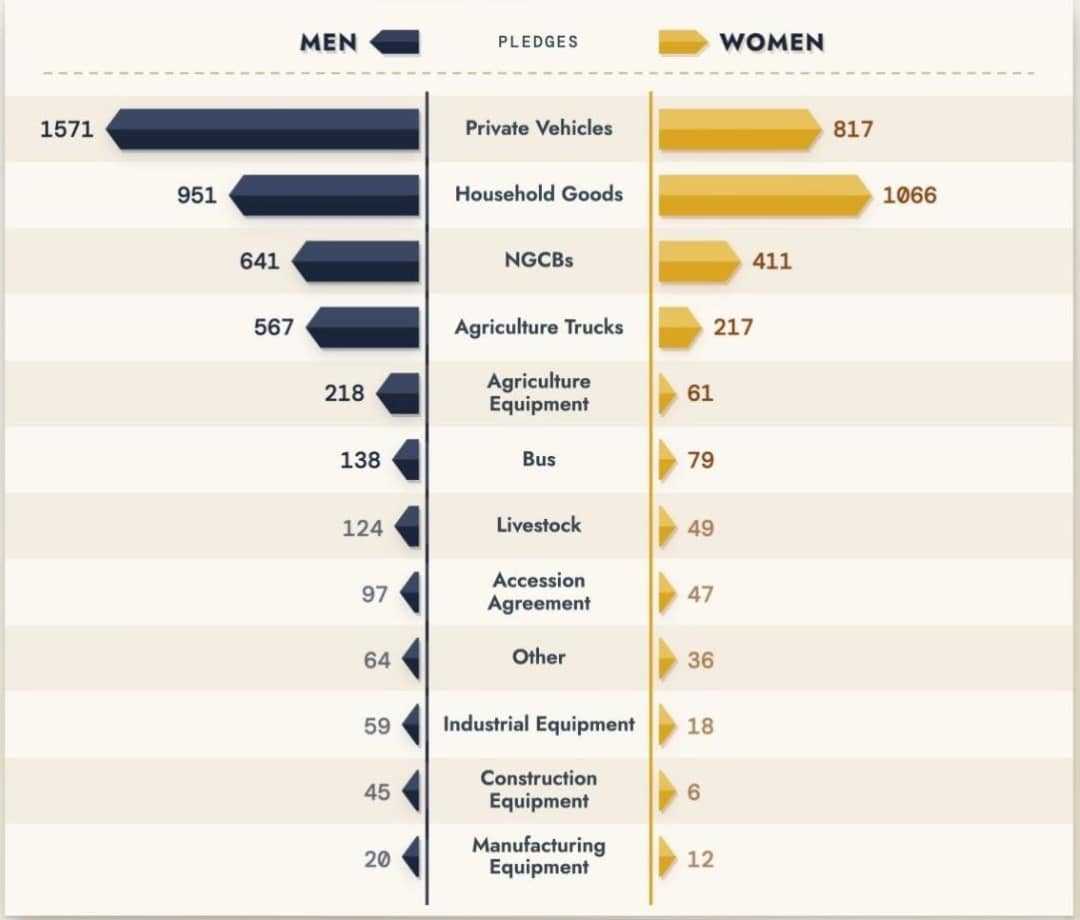
Data attributed to Reserve Bank of Zimbabwe National Payment Systems reports shows men pledging 1,571 private vehicles, almost twice the 817 pledged by women.
Men also recorded higher pledges across most other categories in the dataset, including 641 NGCBs against 411 for women, 567 agricultural trucks against 217, 218 agricultural equipment assets against 61, 138 buses against 79 and 124 livestock assets against 49.
Women exceeded men in only one category, household goods, with 1,066 pledges compared with 951 by men.
The pattern is significant because collateral is more than a requirement imposed by a lender. It provides a snapshot of the assets households and businesses possess and can convert into access to formal credit.
It also raises a wider question for Zimbabwe's financial system: are men and women entering the formal credit market with comparable productive assets behind them?
In its 2024 monetary policy review, the central bank said there was a “significant trend in asset-backed lending among women borrowers”, with women using a variety of movable assets to secure credit.
The Bank specifically noted that “household goods represent a substantial fraction of the total movable collateral provided by women.”
At 30 June 2024, the RBZ recorded women pledging 308 household goods, compared with 263 private vehicles. Women also pledged 88 NGCBs, 80 trucks, 19 buses, 19 livestock assets and 18 agricultural equipment assets.
The RBZ said the collateral being used by MSMEs included trucks, construction equipment, agricultural equipment and NGCBs, illustrating the growing range of assets being brought into the formal lending system.
The latest gender data attributed to the NPS reports shows that this distinction remains visible in the composition of collateral. Men have a substantial lead in vehicles and equipment, while women are more concentrated in household assets.
The difference matters because the economic value of collateral is not necessarily the same across asset classes.
A vehicle, agricultural truck or piece of agricultural equipment can potentially remain in productive use while securing a loan. Household goods can also unlock finance, but they are generally not directly involved in production.
That does not mean that loans secured by household goods are necessarily unproductive, nor does the collateral data establish how borrowers ultimately used the money.
It does, however, show the asset base against which formal credit is being secured.
Related Stories
The RBZ established its Collateral Registry specifically to broaden that asset base. The central bank says the secured-transactions system is intended to “increase the scope of qualifying collateral acceptable to lending institutions”, allowing entrepreneurs and households to leverage movable assets to obtain finance.
The Registry allows lenders to register and search security interests over movable property, while borrowers can continue using pledged assets in their businesses or households.
The RBZ says movable collateral can include equipment, inventory, accounts receivable, farm products, vehicles, household items, fixtures and bank accounts.
That framework is particularly important in Zimbabwe, where conventional bank lending has historically been constrained by requirements for immovable property as security.
The collateral registry attempts to address that problem by allowing borrowers who may not own buildings or land to use other assets to obtain credit.
If men own more vehicles, agricultural equipment, trucks and other productive assets, they have a broader pool of property that can potentially be converted into credit. Women may gain access to the same formal lending infrastructure, but if their available collateral is concentrated in household goods, the value and potential use of the resulting credit can be different.
The RBZ's 2026 Monetary Policy Statement provides further evidence of the gender difference, although its figures are for a different reporting period from the dataset above.
As at 31 December 2025, the RBZ recorded 1,412 private vehicles pledged by men against 703 by women. Women, however, pledged 912 household goods against 820 by men. Men also led in tractors, agricultural equipment, buses, livestock, industrial equipment and construction equipment.The central bank said
“Although men continue to pledge higher volumes overall, women are actively utilising movable assets, particularly within the lower to mid-value categories, which reflects increasing financial inclusion and confidence in formal lending systems.”
The data should not simply be interpreted as evidence that women are excluded from formal credit. The RBZ's own assessment is that women's use of movable assets represents growing participation in asset-backed lending.
The distinction is particularly relevant to small and medium-sized enterprises. A business owner seeking finance to purchase productive equipment needs collateral capable of supporting the size of the loan required. If a potential borrower has only household goods available, the collateral constraint may remain even though the financial system formally accepts those goods.
A growing number of collateral registrations can indicate that more people are entering the formal financial system. It does not necessarily mean that they are accessing sufficient capital to expand production, acquire equipment or build businesses.
The RBZ's own collateral data illustrates the scale of the system. At the end of 2025, household goods were the largest collateral category, with 5,908 registrations, followed by private vehicles at 3,370, title deeds at 2,142, livestock at 1,900 and agricultural equipment at 1,342.
The dominance of household goods is significant because it shows that Zimbabwe's movable-collateral market is not confined to commercial assets. Household wealth is increasingly being brought into the formal credit system.
That can widen financial access, but it also raises questions about the purpose and risk of borrowing.
For women, the difference between owning a vehicle, agricultural machine or commercial equipment and owning household goods is therefore more than a difference in what can be pledged to a bank. It can determine the amount and type of capital available for business activity.







Leave Comments